
Department of Anthropology

Digging Up Y2K
By the third excavation attempt, everyone involved had started to wonder if the missing time capsule had become more myth than history. There had already been two attempted digs behind the Walls Elementary School sign. Shovels hit rocks. Soil was moved carefully by hand. Old memories were teste���
Cracking a 1,400-Year-Old Prehistoric Mystery
For thousands of years, ancient hunters across North America relied on the atlatl ��� a lever-powered spear-throwing device ��� to pursue prey. Then, about 1,400 years ago, something changed fast.A new study co-authored by Metin I. Eren, Ph.D., a professor in the Department of Anthropology at 蹤獲扦���
Researchers Suggest New Hypothesis for Hominin Invention of Stone Cutting Tools
The use of stone hammers to produce sharp stone flakes ��� knapping ��� is traditionally thought to be a process that ancient humans started doing intentionally or by accident before looking for things, such as animal carcasses and hard fruits, to cut. It is a defining feature of hominins and is seen as���
IN A FLASH: Testing Prehistoric Technology
In Assistant Professor Michelle Bebber's class, students learn how prehistoric people hunted for food and learn to use the ancient weapons they used.

What Makes Us Human?
Fifty years ago, 蹤獲扦 Distinguished Professor Owen Lovejoy, Ph.D., was among the very first researchers to study the remains of the famous ���Lucy��� (Australopithecus afarensis), a 3-million-year-old fossil that had recently been discovered by paleoanthropologist Donald Johanson in Hadar, Ethiopia.

England, Egypt and Now ��� Ohio
蹤獲扦 alumnus and Professor Emeritus help Hopewell earthworks in Ohio earn UNESCO World Cultural Site designation.
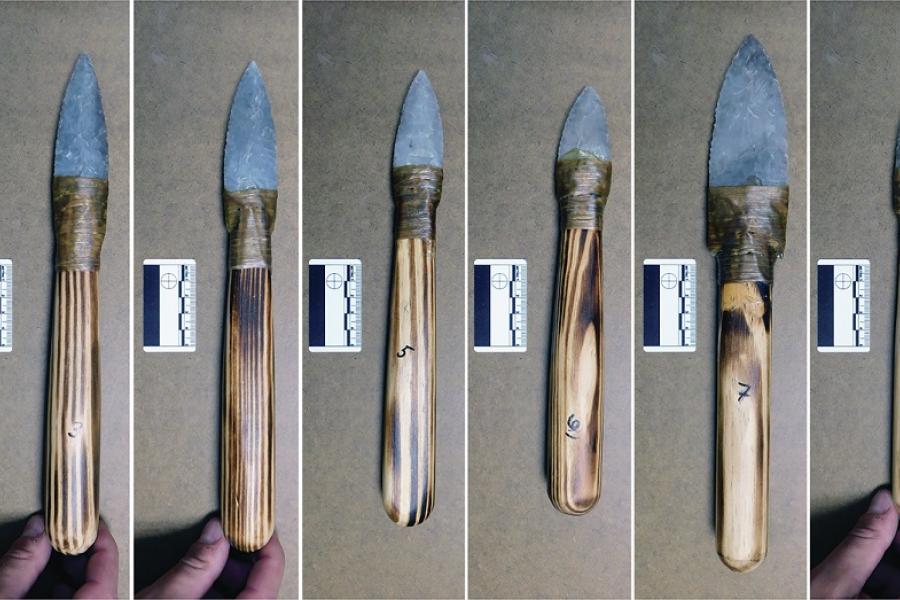
Experimental collaboration between archaeologists and MeatEater highlights the prevalence of equifinality in archaeological interpretation
蹤獲扦���s experimental archaeologists, along with those from several other universities, joined forces with the popular hunting, outdoors, and conservation media platform, MeatEater, Inc., for a unique animal processing experiment, shedding new light on ancient stone knives and showcas���
IN A FLASH - FLASHBACK: Views from Anuta, Solomon Islands
Professor Emeritus Richard Feinberg shared images from his research expeditions to the Polynesian island of Anuta.

We Are Here for the Students: Anthropology Professor Discusses Importance of Mentorship
Metin Eren, Ph.D., associate professor of archaeology at 蹤獲扦, was recently interviewed on a CITI ���On Campus��� podcast hosted by Ed Butch and shared his insights on the importance of mentoring students. ���It���s something that all faculty need to take very seriously,��� Eren said���
Atlatl Weapon Use by Prehistoric Females Equalized the Division of Labor While Hunting: 蹤獲扦 Archaeology Professors Led the Experimental Study
A new study led by Archaeologist Michelle Bebber, assistant professor in 蹤獲扦���s Department of Anthropology, has demonstrated that the atlatl (i.e. spear thrower) functions as an ���equalizer,��� a finding which supports women���s potential active role as prehistoric hunters.